
There are few beers that test the palate and challenge adventurous drinkers like a doppelbock. And here in Texas, the bock is king, with its beefier brother, the doppelbock, often quietly appearing in seasonal fashion in springtime. Naturally, we have to give them all a try, and that brings us to Altstadt’s Year Lator, a beer once only served in their taproom in Fredericksburg, TX, which has now been gifted to the rest of us in tall cans.
If you don’t know anything about Altstadt, know that they are dedicated to brewing classic German beers with German laws, ingredients, and techniques. (And they really do have a great taproom, so go if you can.) Using that ancient Teutonic beer knowledge to their advantage, Altstadt utilizes decoction mashing to break down Vienna, Munich, and Abbey malts for a deep, full, and rich doppelbock that comes in at 8.0% ABV and 25 IBU.
Decoction mashing in its simplest form is where part of the grain is boiled, cracking open the hulls and increasing enzyme activity to bring out layers and layers of malt. Honestly, any time we hear of someone doing this we get very excited, so let’s see how Altstadt did.
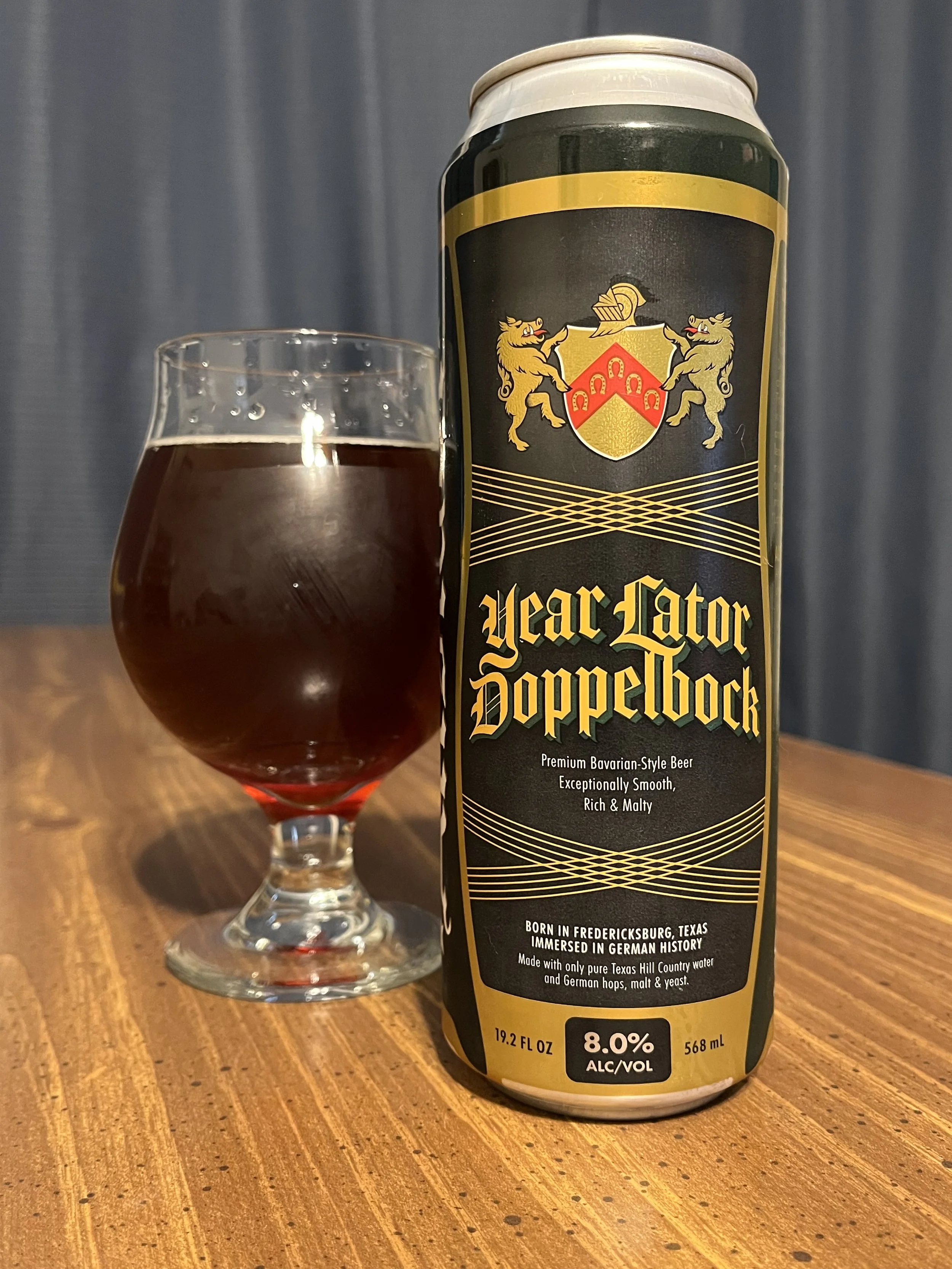
First Impressions:
On the Eyes--Deep ruby (quite striking, really), clear, but flecked with hop goodness, and topped with a thin beige head that diminishes quickly.
On the Nose--Layers and layers of malt with the clean Vienna and toasted Munich leading the charge. Clean, sweet, and a touch hoppy.
On the Palate--The layers of malt surge forward with caramel and gentle roasted hints at the front followed by a deep raisin/dried fruit (from the Abbey malt) flavor that offers an essence of grape with the help of the high ABV and strong floral hop presence. Full-bodied and very smooth, Year Lator finishes quite dry with the fruity notes lingering in what is a pretty clean finish for such a malty, complex beer.
Beer Note: Year Lator might appear like an unfortunate error, but traditionally doppelbocks end with the suffix -ator, like Paulaner’s Salvator and Ayinger’s Celebrator.
Final Thoughts:
Doppelbocks are complex beasts, and I consider them one of the hardest beers to get into. And with such heavy malt applications, they really do come in a diversity of flavors and ABVs. Typically they are roasted and rich with flavors of caramel and dried fruit which pair well with the high ABV sipper, but they need to retain some of that German clarity and tradition, which Altstadt definitely does.
Year Lator, like any good doppelbock, has a lot going on. It’s wildly complex, sending the sipper on a high ABV exploration of malt. Whether through decoction mashing or heavy hopping, Altstadt has knocked off some of the harshness that other doppelbocks have, while keeping the ABV on the higher end of the style. It has great balance of malt, with the Vienna, distinct and clean, at the front, the roasted Munich in the middle, and the deep and complex Abbey rounding it out. It finishes clean, and the sip is full and smooth—and it’s an Altstadt beer for sure! I will add with a lot of honesty Year Lator is one of the more interesting beers I’ve tried in a long time. Can’t wait to try it in their taproom.
Cheers!
Mr. Brew